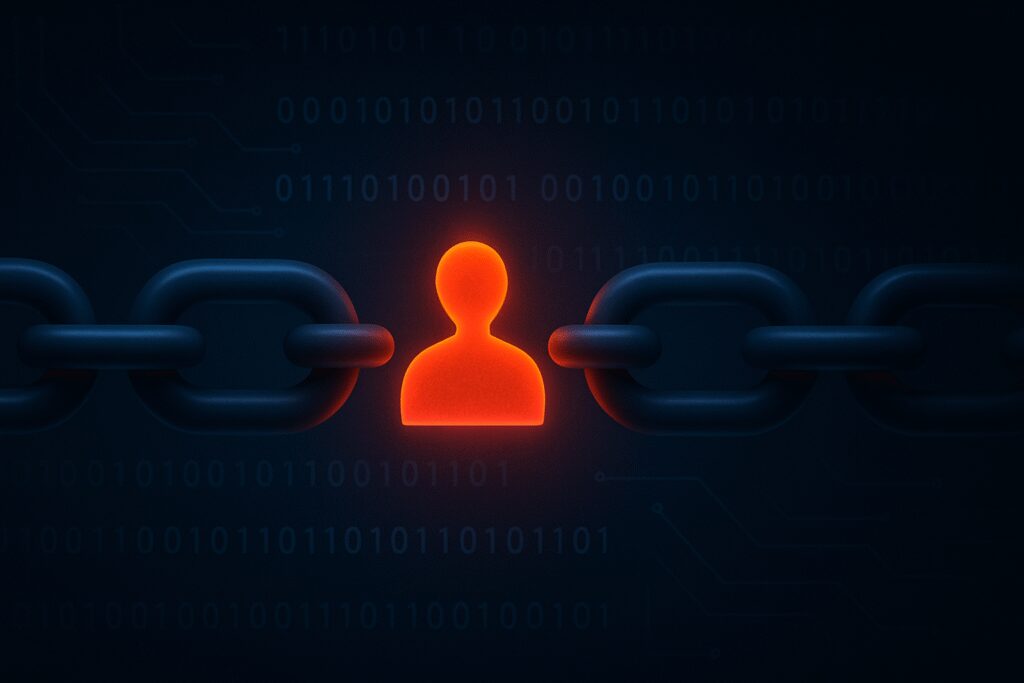


Why are people the weakest link in cybersecurity?
New technology brings new cyber threats, and what follows is a tightening of cybersecurity measures to keep your data safe. But despite stronger security systems and advances in technology, there is still a lack of guidance around human behaviours in cybersecurity.
This post looks at why people are the most exploited vulnerability in cybersecurity. We’ll cover what makes people the weakest link, the most common human errors, and why the errors are damaging.
What makes people the weakest link in cybersecurity?
Cybersecurity systems are robust – programmed and coded to do something without overcomplication. But the people who rely on these systems are unpredictable, with an innate trustworthiness which can be exploited.
A lack of cybersecurity knowledge, coupled with sophisticated tactics from hackers, such as creating urgency or mimicking trusted individuals, can lead to significant data security issues that no amount of technology can compensate for.
What are the most common human errors in cybersecurity?
Weak passwords
Weak, predictable, and often reused passwords can compromise your data massively.
Passwords like “123456” or “111111” are among the most common passwords that can be cracked in under a second by a cybercriminal.
Following that, passwords that include your pet’s name, or your favourite football player, followed by “123” aren’t a great alternative either, as they’re only slightly stronger, taking a couple of seconds to crack.
Use a password manager with a strong password generator that creates and safely stores a strong, unique password. That way, you won’t have to remember a jumble of numbers, letters, and special characters, and your accounts stay secure.
No two-factor authentication (2FA)
Many people skip setting up two-factor authentication, leaving their accounts protected by just their password. Even with a strong, unique password, if a cybercriminal gains access, then they have free rein over your account.
2FA and MFA (multi-factor authentication) are an extra layer of security that protects you even if your password has been compromised.
Using your mobile phone number or an authenticator app, you can easily put the protection in place to prevent cybercriminals from accessing your account
Read more: What is two-factor authentication, and why is it important?
Phishing attacks
Phishing attacks often catch humans off guard. Playing into impulsive human behaviours like creating urgency to do something, a cybercriminal can prompt you to click a link filled with malware or send over personal information.
How do you counter these if they slip through the cracks? Simple. Double-check these emails for spelling errors, strange-looking attachments, and an email address that is slightly off.
Read more: 7 ways to spot a phishing email.
Why are these errors so damaging?
Your business can suffer significant damage due to human errors in cybersecurity, which begins with a data breach. This can result in financial loss, possible reputational harm to your business, and regulatory penalties.
Human errors caused some of the most costly data breaches.
The recent Marks and Spencer ransomware incident (2025) was caused by compromised employee details that resulted in disruption to payment systems and online orders. This led to financial loss, service disruption, and the exposure of customers’ personal information. So, how do you prevent human errors from damaging your business?
- Provide regular cybersecurity training to your employees to keep them aware. By keeping them informed, you’re likely to suffer fewer issues with phishing and social engineering attacks.
- Educate them on strong passwords and introduce a password manager along with MFA and 2FA for extra security.
- Have a strong cybersecurity and IT support team by your side
A final thought
You can have the strongest security systems in place, but it only takes one unaware member of the team to fall victim to a cyber attack, and you could end up with a bill for lost revenue and long-term reputational damage.
Keep yourself and your team informed to stay ahead of cyber attacks.